How Does Recarburizer Quality Affect Casting Quality?
Recarburizers are classified into three categories: graphitized, semi-graphitized and non-graphitized, according to calcination temperature, calcination time, as well as residual sulfur and residual nitrogen contents after calcination. Fully-calcined graphitized recarburizers normally feature residual sulfur below 0.05 % and residual nitrogen below 0.03 %. Carbon atoms are arranged in an ordered regular hexagonal lattice, delivering fast dissolution and high absorption efficiency during melting. In contrast, insufficiently-calcined semi-graphitized or non-graphitized recarburizers contain relatively high residual sulfur and nitrogen. Their carbon atoms exhibit disordered dislocation arrangements, leading to slow dissolution and low carbon absorption during melting. Literature sources recommend graphitized recarburizers for manufacturing high-density gray iron, ductile iron and vermicular graphite iron castings to prevent relevant casting defects.This paper summarizes the influences of recarburizer quality on nitrogen porosity, shrinkage porosity, machinability and graphite spalling of castings, providing references for rational selection and application of recarburizers.
1 Effect of Recarburizer Quality on Nitrogen Porosity in Castings
Nitrogen porosity defects appear as crack-like features at casting hot-spots or upper-mold surfaces, directly impairing casting density, mechanical properties and acceptance rate. Scanning electron microscopy (SEM) observation reveals three typical surface morphologies for nitrogen-porosity defects: turtle-shell patterns, globular dendrite tips and surface carbon films (Figure 1).
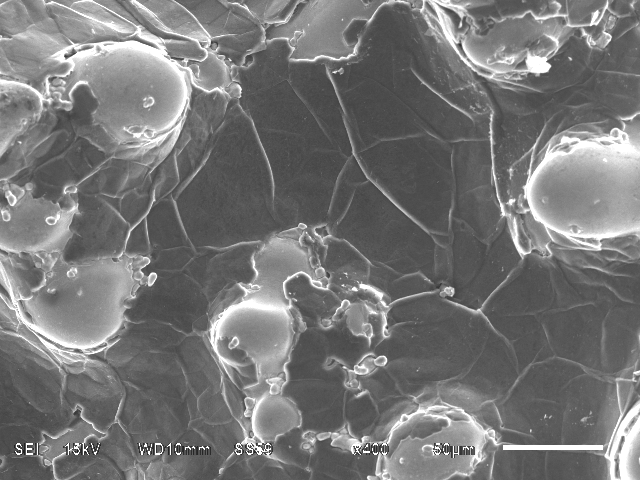
Figure 1 SEM micrograph of nitrogen porosity
Relevant literature indicates that nitrogen gas precipitates and forms nitrogen porosity during solidification once nitrogen concentration in molten iron exceeds a critical threshold. A nitrogen content no higher than 120 ppm in molten iron is recommended. Generally, for synthetic-cast-iron melting without additional carbon-bearing materials, recarburizer accounts for 2.0 ~ 2.5 % of the total furnace charge. When semi-graphitized recarburizer is adopted, every 1.0 % addition raises molten-iron nitrogen by 20 ~ 40 ppm. For non-graphitized recarburizer, each 1.0 % addition increases nitrogen content by 50 ppm or above. Since molten-iron nitrogen is comprehensively affected by melting procedures, charge materials and core-mold materials, low-nitrogen graphitized recarburizers constitute a prerequisite for mitigating nitrogen-porosity risks in castings.
2 Effect of Recarburizer Quality on Shrinkage Porosity in Castings
Shrinkage porosity is one of the most common cavity-type defects, distributed at or adjacent to casting hot-spots. SEM examination shows well-developed austenite dendrites on defect surfaces, characteristic of solidification-shrinkage defects (Figure 2).
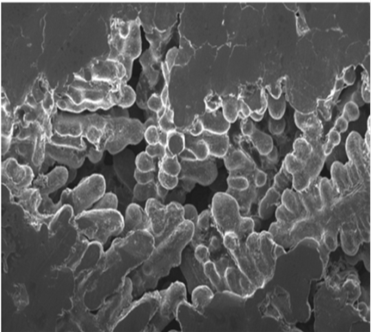
Figure 2 SEM micrograph of shrinkage-porosity defect
During solidification, gray iron and ductile iron undergo both solidification shrinkage and graphitic expansion. At eutectic transformation, carbon atoms or carbon-atom clusters continuously accumulate at graphite growth fronts, generating volumetric expansion from graphite formation. Literature states that under proper conditions, effective graphitic expansion can fully compensate solidification-induced volume contraction and avoid volume deficit, which is critical for shrinkage-porosity reduction.
What constitutes effective graphitic expansion? As mentioned above, fully-calcined recarburizers feature carbon atoms arranged in ordered regular-hexagonal lattices. They dissolve rapidly and completely in high-temperature molten iron; dissolved carbon atoms/clusters provide favorable conditions for graphite nucleation and growth. By comparison, insufficiently-calcined recarburizers have carbon atoms with disordered dislocation arrangements. Dislocations act like knots in hemp rope, hindering dissolution and prolonging dissolution time. Portions of undissolved recarburizer persist in molten iron until solidification completes. Even when bulk carbon content meets process targets, graphite growth is suppressed, and the corresponding graphitic volumetric expansion weakens, raising shrinkage-porosity risks.
A practical observation: non-graphitized recarburizers cannot produce black marks on paper and tend to scratch paper surface. Highly-graphitized recarburizers, by contrast, leave smooth, distinct black traces similar to a 2B pencil. This obvious macroscopic difference reflects ordered versus disordered carbon-atom arrangement, and explains their divergent dissolution behavior under thermodynamic conditions.
3 Effect of Recarburizer Quality on Machinability of Castings
Poor machinability represents a long-standing pain point in the foundry industry. According to published references, given identical chemical composition, inoculation practice and cooling conditions, the metallurgical quality of base molten iron dominates casting machinability. Fully-calcined graphitized recarburizers serve as effective pre-conditioning agents for molten iron. They increase heterogeneous nucleation sites, reduce eutectic-transformation undercooling, mitigate chill tendency, homogenize casting microstructure and narrow hardness scatter. Particularly, fine-particle recarburizer (0.3 ~ 0.8 mm diameter) added with stream-inoculation at tapping delivers remarkable pre-conditioning performance alongside carbon replenishment.
Semi-graphitized and non-graphitized recarburizers with inadequate calcination exhibit poor and slow dissolution. They reduce or contaminate effective nucleation sites in molten iron, degrading melt metallurgical quality. This increases undercooling and chill tendency, triggering excessive carbide formation, wider hardness variation and deteriorated machinability.
4 Effect of Recarburizer Quality on Graphite Spalling
Graphite spalling is a key index for post-machining surface finish, commonly quantified by Rz roughness value. Spalled graphite appears as bright-black pock-marks on surfaces. SEM observation shows steep-profile features at graphite-spalling defect locations (Figure 3).
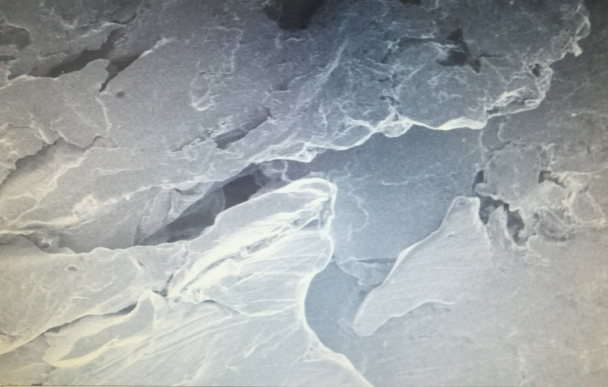
Figure 3 SEM micrograph of graphite spalling defect
Literature reports that coupled growth occurs between graphite and austenite during eutectic transformation for gray iron, ductile iron and vermicular graphite iron. Carbon-atom arrangement within recarburizers governs the coupled-growth relationship between graphite and austenite.
Where carbon atoms are orderly arranged, recarburizer dissolves into carbon atoms or carbon-atom clusters that support graphite growth; austenite grows concurrently with graphite. This coupled-growth interface delivers strong bonding strength. Graphite is resistant to spalling under high-speed shearing force from cutting tools.
Where carbon-atom arrangement is disordered, incompletely-dissolved recarburizer disperses within molten iron without participating in normal graphite growth. It remains embedded in casting microstructure, merely mechanically mixed with surrounding austenite with weak interfacial bonding. Subjected to high-speed cutting-tool shear stress, these dispersed residual graphite phases readily spall, forming surface pits and degrading machined-surface finish.
For synthetic-cast-iron production, the graphitization degree of recarburizer is a vital factor governing casting quality. Residual-sulfur and residual-nitrogen contents act as key indicators for recarburizer graphitization level. For critical-component production, graphitized recarburizers with residual sulfur ≤ 0.05 % and residual nitrogen ≤ 0.03 % are recommended. Such material minimizes nitrogen-porosity risk, offsets solidification shrinkage tendency, improves machinability and enhances machined-surface finish.
It should be specially noted that excessively low nitrogen in molten iron is not desirable. Mass-production experience demonstrates that moderate nitrogen addition to gray iron rounds off flake-graphite tips, thickens, shortens and bends graphite flakes, raises pearlite fraction, and improves gray-iron strength and hardness.
Literature suggests manganese-nitride alloy as the preferred nitrogen-boosting additive for gray-iron production, with base-melt nitrogen controlled within 90 ~ 110 ppm.
Copyright Notice: This content is original and exclusive. All rights reserved. Reprinting, reproduction and commercial use are prohibited without authorization. Violators shall be held accountable!